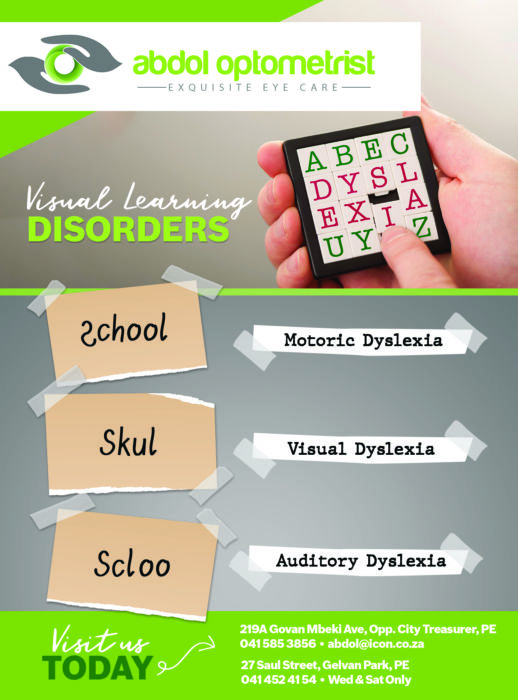

The following information was written by Dr Zakkie Abdol from Abdol Optometrist. Dr Abdol has a specialist in the field of diagnosing dyslexia:
Dyslexia:
For centuries professionals have been querying the phenomenon of a scholar who may have normal sensory , perceptual ,cognitive and motor abilities, and yet have marked difficulties decoding (reading) and encoding (spelling) the written language. Parents of these children recognise their children’s natural intelligence , but are puzzled as to why there is a problem with reading , writing and spelling. This paradoxical phenomenon is known as Dyslexia.
Definition:
The International Dyslexia Association (IDA) defines Dyslexia as a neurological-based , often hereditary disorder that interferes with the acquisition and processing of language. There are 7 types of reading Dyslexia which varies in degrees of severity. In addition , there are 2 types which sometimes manifests as difficulties in Arithmetic (Dyscalculia) and handwriting (Dysgraphia). It has no boundary as regards to geography , culture ,socioeconomic status , language ,gender , or age.
Facts:
– Dyslexia affects 1 out of 5 children (20%)
– Dyslexia affects approximately the same number of boys as it does girls.
– Dyslexia is the leading cause of reading failure and school dropouts.
Key features of people with Dyslexia :
– Feels dumb, has poor self-esteem and confidence.
– Often confuses left/right , over/under , etc
– Poor spelling and phonics – Average or above-average intelligence – Reads or writes with additions, omissions, substitutions, reversals of letters – Becomes easily frustrated and emotional about school and uses avoidance tactics.
To book a consultation or dyslexia assessment find Abdol Optometrists at www.abdoloptom.co.za.
More details can be found on the Dyslexia Academy website : www.sgda.co.za